
If you ride a scooty every day—whether it’s for office, college, or daily errands—you already know how important it is in Indian life. From busy roads of Delhi to small towns, scooty has become a part of our routine.
But here’s something interesting:
Most people ride their scooty daily, yet they don’t know the basic body parts names. When something breaks, they simply say, “bhaiya aage wala part toot gaya” 😄
Understanding scooty body parts is not just for mechanics—it helps you:
- Talk confidently at service centers
- Avoid being overcharged
- Maintain your vehicle better
In this simple guide, I’ll explain all the important scooty body parts names in easy English with practical examples.
What Are Scooty Body Parts?
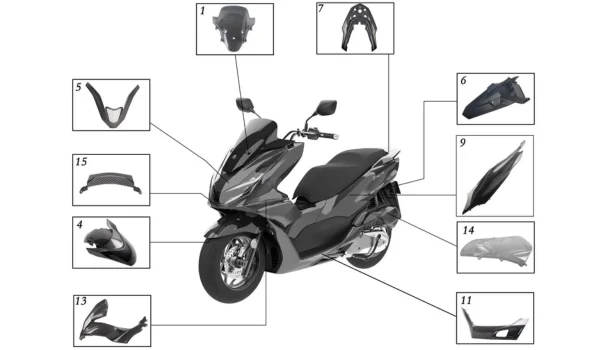
Scooty body parts are the outer structure and panels that cover and protect internal components like:
- Engine (in petrol scooties)
- Battery (in electric scooties)
- Wiring and electronics
Think of them as the “body” or “cover” of your scooty that keeps everything safe and gives it a stylish look.
Popular models like Honda Activa scooter and TVS Scooty Pep Plus use similar body parts design.
Main Scooty Body Parts Name (Front to Back)
Let’s understand each part step by step.
- Front Apron (Front Body Panel)
This is the front part of the scooty, located just below the handlebar.
Functions:
- Protects wiring and internal parts
- Holds indicators and sometimes headlight
- Improves aerodynamics
👉 This is one of the most commonly damaged parts in minor accidents.
- Headlight Cowl
The headlight cowl is the cover around the headlight.
Functions:
- Protects the headlight
- Gives a stylish look
- Holds LED or halogen light setup
Modern scooters like Ola S1 electric scooter have sleek LED headlight cowls.
- Handlebar Cover
This part surrounds the handle area.
Includes:
- Speedometer
- Indicator switch
- Horn button
Functions:
- Protects electrical wiring
- Gives clean finishing
- Leg Shield
This is the vertical panel in front of your legs.
Functions:
- Protects from dust, mud, and water
- Shields legs from wind
👉 Very useful during rainy season in India.
- Floorboard (Footboard)
This is where you place your feet while riding.
Functions:
- Provides comfort
- Allows carrying small items
In India, people often use it to carry:
- Grocery bags
- Office bags
- Water bottles
- Side Panels (Side Body Covers)
These are panels on both sides of the scooty.
Functions:
- Cover engine or battery
- Protect internal parts
- Improve design
In electric scooters like Ather 450X electric scooter, these panels protect the battery pack.
- Seat
The seat is where the rider and pillion sit.
Functions:
- Provides comfort
- Covers storage area
Seats can be:
- Soft cushioned
- Long and wide for family use
- Underseat Storage (Boot Space)
Located under the seat.
Functions:
- Store helmet
- Keep documents
- Carry tools
Scooters like Suzuki Access 125 scooter are known for large storage space.
- Rear Body Panel
This is the back portion of the scooty.
Functions:
- Supports tail light
- Protects rear components
- Adds design styling
- Tail Light Assembly
Located at the rear end.
Functions:
- Brake light
- Indicator lights
- Night visibility
- Mudguard (Front & Rear)
Mudguards are placed above wheels.
Functions:
- Prevent mud and water splashes
- Keep rider and clothes clean
👉 Very important for Indian roads, especially during monsoon.
- Grab Rail (Pillion Handle)
This is the handle at the back.
Functions:
- Helps pillion hold
- Useful for moving the scooty
- Number Plate Holder
Holds the vehicle’s registration plate.
Functions:
- Keeps number plate secure
- Mandatory by law
- Kick Panel (Petrol Scooty)
Located near the kick-start lever.
Functions:
- Supports kick-start mechanism
- Protects nearby components
- Battery Cover (Electric Scooty)
Only in electric scooties.
Functions:
- Protects battery pack
- Prevents dust and water damage
Material Used in Scooty Body Parts
Most scooty body parts are made of:
- Plastic (Fiber Panels)
- Lightweight
- Affordable
- Easy to replace
- Metal (Rare in New Models)
- Strong but heavier
👉 That’s why panels break easily in accidents but are cheap to replace.
Common Problems in Scooty Body Parts
Due to Indian road conditions, body parts often face:
🔧 Common Issues:
- Scratches from traffic
- Cracks after falling
- Broken panels in accidents
- Faded color due to sunlight
Repair & Replacement Cost in India
Here’s an approximate cost:
| Part | Price Range |
| Front Apron | ₹800 – ₹2000 |
| Side Panel | ₹500 – ₹1500 |
| Headlight Cowl | ₹700 – ₹2500 |
| Seat | ₹1000 – ₹3000 |
| Mudguard | ₹300 – ₹1000 |
👉 Prices vary depending on model and brand.
Why You Should Know These Parts
Many people ignore this, but it’s very useful.
✔ Better Communication
Instead of saying:
👉 “Scooty ka side wala part toot gaya”
You can say:
👉 “Side panel damage ho gaya”
✔ Avoid Extra Charges
Knowing parts helps you understand repair bills.
✔ DIY Maintenance
You can identify small issues yourself.
Petrol vs Electric Scooty Body Parts
Most body parts are similar, but some differences exist:
Petrol Scooty:
- Engine cover
- Fuel tank section
Electric Scooty:
- Battery compartment
- Charging port panel
Example:
- Honda Activa scooter → petrol
- Ola S1 electric scooter → electric
Tips to Protect Scooty Body Parts
✔ Use Crash Guard
Protects panels in minor accidents.
✔ Park Carefully
Avoid scratches in tight spaces.
✔ Use Cover
Protects from sunlight and rain.
✔ Wash Regularly
Keeps paint in good condition.
Final Thoughts
Scooty body parts may look simple, but they play a big role in:
- Safety
- Comfort
- Protection
- Style
Once you understand these parts, you’ll feel more confident while riding and maintaining your vehicle.
Next time you visit a mechanic, you won’t feel confused—you’ll know exactly what your scooty needs.