
Consumers may sometimes face problems such as defective products, poor services, delayed delivery, unfair business practices, wrong billing, refund issues, or misleading advertisements. When a company, seller, service provider, or other business does not properly resolve a genuine complaint, a consumer can consider using the consumer grievance redressal system in India.
The Consumer Protection Act, 2019 provides a three-tier system of Consumer Commissions at the District, State, and National levels. The law also provides for online filing of consumer complaints, making it possible to pursue a complaint without depending entirely on physical filing.
What Is a Consumer Complaint?
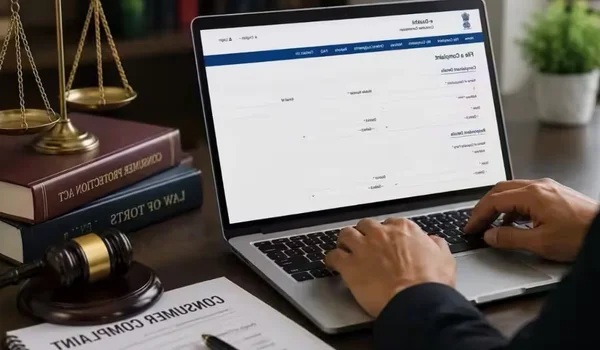
A consumer complaint is a formal complaint raised by a consumer regarding a problem with goods or services.
Common examples include:
- Defective products
- Poor-quality services
- Failure to provide promised services
- Delayed delivery
- Non-delivery of goods
- Refund disputes
- Incorrect billing
- Unfair trade practices
- Misleading advertisements
- Problems with online purchases
- Deficiency in services
The Consumer Commission can provide appropriate relief where a complaint is established, including compensation in suitable cases.
Try to Resolve the Problem First
Before filing a formal consumer case, it is usually useful to contact the seller or service provider and explain the problem.
Keep records of:
- Customer-care complaints
- Emails
- Messages
- Complaint numbers
- Invoices
- Bills
- Payment records
- Warranty documents
- Photographs or videos of defective products
- Responses received from the company
A written complaint creates a record showing that you gave the business an opportunity to resolve the issue.
Use the National Consumer Helpline
The National Consumer Helpline (NCH) provides a pre-litigation grievance-redressal mechanism. Consumers can register grievances through its online system and other channels. The Department of Consumer Affairs currently lists 1915 as the toll-free helpline and also provides online, WhatsApp, SMS, email, app, and UMANG options.
The NCH process can be useful when you want to raise the issue with the business before considering a formal Consumer Commission case.
When submitting a grievance, provide complete information about the transaction and upload relevant documents. A docket number is provided after the grievance is registered.
What Is e-Jagriti?
For formal consumer cases, the online filing system has evolved from the earlier e-Daakhil platform into the Department of Consumer Affairs’ e-Jagriti system. The Department describes e-Jagriti as an integrated platform intended to bring together earlier consumer-case systems and support online filing, case management, and related processes.
This is different from simply registering a grievance with the National Consumer Helpline. A consumer complaint before a Consumer Commission is a formal legal proceeding.
Prepare Your Documents
Before starting an online complaint, organise all relevant documents.
Depending on the dispute, these may include:
- Purchase invoice
- Payment receipt
- Order confirmation
- Warranty card
- Service agreement
- Bank or UPI transaction record
- Emails
- WhatsApp or other relevant messages
- Photographs
- Videos
- Previous complaints
- Customer-care responses
- Refund requests
- Legal notices, if any
- Other documents supporting your claim
Scan or photograph documents clearly so that they can be uploaded when required.
Prepare a Clear Description of the Problem
Write down what happened in chronological order.
Include:
- Date of purchase or service
- Name of seller or service provider
- Product or service involved
- Amount paid
- Nature of the problem
- Date on which you complained to the business
- Response received
- Relief you are seeking
Keep the description factual. Avoid unnecessary emotional statements or unsupported allegations.
Identify the Relief You Want
A complaint should clearly explain what you want the Consumer Commission to consider.
Depending on the circumstances, a consumer may seek appropriate relief such as:
- Refund
- Replacement
- Repair
- Compensation
- Removal of deficiency in service
- Correction of an unfair practice
- Other appropriate relief available under consumer law
The exact relief depends on the facts and legal basis of the complaint.
Check Where You Can File
The Consumer Protection Act, 2019 introduced more flexibility regarding jurisdiction. The Department of Consumer Affairs states that a consumer can file a complaint in the Consumer Commission having jurisdiction over the place of the consumer’s residence or work, irrespective of where the transaction took place.
However, jurisdiction and the appropriate commission can depend on the nature and value of the dispute and the applicable rules. Therefore, check the current requirements on the official filing system before submitting the case.
Create an Account and Start the Filing Process
Once your documents and complaint details are ready, access the current online consumer-case filing platform and create or use your account as required.
The earlier e-Daakhil process involved registration through email, OTP verification, account activation, and complaint registration. The current system has been integrated into e-Jagriti as part of the Department’s digital consumer-protection platform.
Follow the instructions shown on the portal and enter the requested details carefully.
Enter the Opposite Party’s Details
The complaint normally needs information about the business, seller, manufacturer, service provider, or other party against whom the complaint is being made.
Use the correct legal name and address wherever available. Check invoices, agreements, company communications, or other documents for accurate information.
Incorrect details can create unnecessary complications later.
Upload Supporting Documents
Upload the documents requested by the filing system.
Make sure:
- Documents are readable
- Pages are in the correct order
- Names and dates are clear
- Payment evidence is included
- Important correspondence is preserved
- Files meet the portal’s size and format requirements
Do not upload unrelated personal information unless it is genuinely required for the case.
Pay the Applicable Filing Fee
The applicable fee depends on the type and value of the complaint and the rules in force.
The Department of Consumer Affairs has stated that no fee is required for filing a complaint up to the specified threshold of ₹5 lakh under the applicable consumer-protection framework.
Because fee rules and procedures can change, check the amount displayed by the current filing system before submitting your complaint.
Submit the Complaint Carefully
Before final submission, review all information.
Check:
- Your name and contact details
- Opposite party’s details
- Transaction information
- Complaint facts
- Amount involved
- Relief requested
- Uploaded documents
- Declaration and other required information
Once you are satisfied that the information is accurate, submit the complaint through the portal.
Keep the acknowledgement, filing number, or other reference generated by the system.
What Happens After Filing?
The complaint goes through the applicable Consumer Commission process. The Consumer Protection Act, 2019 also provides that if admissibility is not decided within 21 days of filing, the complaint is deemed admitted under the statutory framework.
The Commission may issue notices and require responses from the opposite party. Further proceedings depend on the facts and documents involved.
Consumer Commissions can also use virtual hearing facilities in appropriate cases, helping reduce the need for physical travel.
Can You File Without a Lawyer?
Yes. The Department of Consumer Affairs states that a consumer can file a complaint personally or through an advocate or agent.
For straightforward matters, a consumer may choose to handle the filing personally. For complicated disputes involving substantial amounts, technical contracts, property-related services, medical services, or difficult legal questions, professional legal advice may be useful.
Common Mistakes to Avoid
When filing a consumer complaint online, avoid:
- Providing incorrect facts
- Uploading incomplete documents
- Using an incorrect address for the opposite party
- Making unsupported allegations
- Asking for unclear relief
- Ignoring notices from the Consumer Commission
- Missing deadlines
- Losing the filing acknowledgement
- Submitting duplicate or unrelated complaints
Keep a complete digital folder containing the complaint, documents, acknowledgements, and subsequent communications.
Final Steps
If you have a genuine consumer grievance, start by approaching the seller or service provider and preserving evidence. You can also use the National Consumer Helpline for pre-litigation grievance redressal. If the matter requires a formal consumer case, the online e-Jagriti system provides a route for filing before the appropriate Consumer Commission.
Conclusion
Filing a consumer complaint online in India has become more accessible through digital consumer-protection systems. The process generally involves identifying the dispute, collecting evidence, attempting grievance resolution, preparing the complaint, selecting the appropriate Consumer Commission, uploading documents, and completing the online filing process.
The most important step is to keep accurate records and provide truthful, complete information. If the dispute is complicated or involves a significant amount of money, taking appropriate legal advice before filing can help you understand the applicable procedure and relief available in your situation.